If you’ve ever experienced a diverticulitis flare after several days of constipation, you’ve probably asked yourself the same question thousands of other people have:
Did the constipation cause it?
It’s an understandable concern. Constipation can leave you feeling bloated, uncomfortable, and painfully aware of every sensation in your abdomen. When severe lower-left abdominal pain follows, it’s natural to connect the two events.
In fact, many people blame themselves after a flare.
“If only I’d eaten more fiber.”
“Maybe I shouldn’t have skipped those vegetables.”
“Did I strain too hard?”
For years, doctors believed constipation was a major cause of diverticulitis. The theory seemed logical: hard stools and straining increased pressure inside the colon, which irritated the small pouches (diverticula) that form in the intestinal wall.
But over the last 15 years, our understanding of diverticular disease has changed dramatically.
Researchers now believe diverticulitis is much more complex than simply “too much pressure in the colon.” Genetics, the gut microbiome, chronic inflammation, diet, lifestyle, and the immune system all appear to play important roles.
So where does constipation fit into the picture?
The answer is surprisingly reassuring.
Current research suggests constipation alone is unlikely to trigger diverticulitis. However, that doesn’t mean it’s unimportant. Constipation can still worsen symptoms, affect your quality of life, and sometimes be one of the earliest signs that a flare is already developing.
Understanding the difference can help you focus on what really matters—and stop blaming yourself for something that may have been outside your control.
The Short Answer
If you’re looking for the quick answer, here’s what current evidence tells us.
Constipation is not considered a direct cause of diverticulitis.
However, it can be associated with diverticulitis in several important ways:
- It may occur before a flare because inflammation slows normal bowel movements.
- It can make abdominal discomfort and bloating feel worse.
- Chronic constipation may reflect lifestyle habits that also affect colon health, such as low fiber intake, dehydration, or inactivity.
- Preventing constipation is still a worthwhile goal, even though it hasn’t been proven to prevent diverticulitis.
In other words, constipation is part of the story, but it probably isn’t the whole story.
Understanding the Difference Between Diverticulosis and Diverticulitis
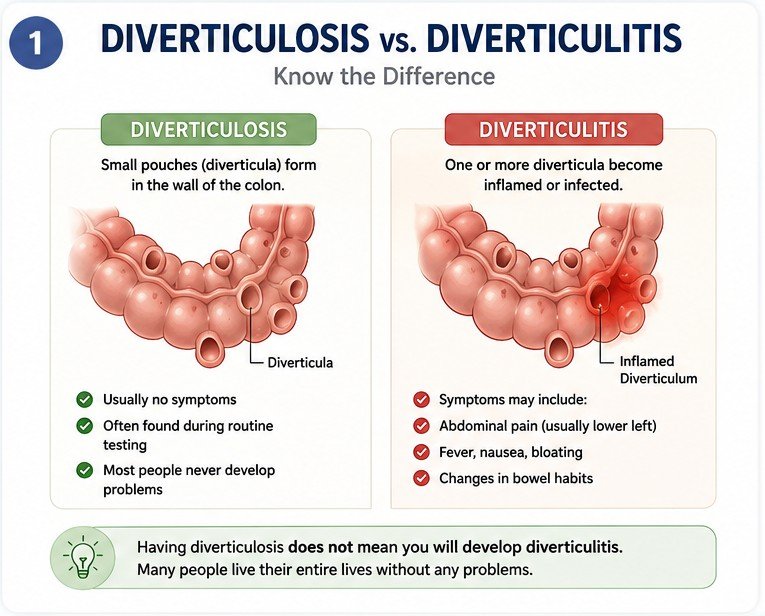
Before looking at constipation specifically, it’s helpful to understand two terms that are often confused.
Diverticulosis
Diverticulosis simply means small pouches, called diverticula, have formed in the wall of the colon.
These pouches become increasingly common with age. By age 60, many adults have diverticulosis without ever experiencing symptoms. Most people discover they have diverticula during a routine colonoscopy performed for another reason.
Having diverticulosis doesn’t mean you’re sick.
In fact, most people with diverticulosis never develop diverticulitis.
Diverticulitis
Diverticulitis occurs when one or more diverticula become inflamed.
Typical symptoms include:
- Pain in the lower left abdomen
- Fever
- Nausea
- Loss of appetite
- Changes in bowel habits
- Tenderness when the abdomen is pressed
Not every episode is severe. Some people recover with rest, dietary changes, and close medical supervision, while others require antibiotics or, in more serious cases, hospitalization.
The important point is this:
Having diverticula doesn’t automatically mean you’ll develop diverticulitis.
That’s why researchers have spent years trying to understand what actually triggers a flare.
Why People Have Believed Constipation Causes Diverticulitis
The connection between constipation and diverticulitis didn’t come out of nowhere.
For decades, doctors taught what became known as the “high pressure theory.”
The theory went something like this:
- A low-fiber diet causes constipation.
- Constipation leads to harder stools.
- Hard stools require more straining.
- Straining increases pressure inside the colon.
- Increased pressure damages or inflames diverticula.
It was a simple explanation that fit what doctors understood at the time.
Because of this, patients were routinely advised to eat more fiber, drink more water, and avoid constipation to prevent diverticulitis.
Some of that advice still holds true today—but not necessarily for the reasons we once believed.
Over the last two decades, researchers began conducting larger, higher-quality studies, and many of the old assumptions started to fall apart.
What Modern Research Has Found
One of the most influential studies was published in Gastroenterology in 2013.
Researchers examined more than 2,000 adults undergoing screening colonoscopies and compared their bowel habits with the presence of diverticulosis.
The results surprised many experts.
People who reported constipation were not more likely to have diverticulosis than those with regular bowel movements.
In fact, some of the findings challenged decades of conventional wisdom.
Since then, researchers have continued to study diverticular disease, and a different picture has emerged.
Rather than being caused by constipation alone, diverticulitis appears to result from a combination of factors, including:
- Changes in the gut microbiome
- Low-grade inflammation within the colon
- Alterations in the immune system
- Aging of the connective tissue in the colon wall
- Genetic susceptibility
- Diet and overall lifestyle
Think of diverticulitis less like a clogged drain and more like a perfect storm.
No single factor explains every case.
Instead, several factors may come together until inflammation develops.
That also helps explain why two people with similar diets can have completely different experiences.
One person may have diverticulosis for decades without ever developing diverticulitis, while another experiences repeated flares despite doing many things “right.”
Clinical Insight
One of the biggest changes in gastroenterology over the last decade is the shift away from blaming a single food or bowel habit for diverticulitis.
Modern research suggests that diverticulitis is a complex inflammatory condition rather than simply a mechanical problem caused by constipation or pressure inside the colon.
That’s good news because it means a single episode of constipation probably didn’t “cause” your flare.
Why Constipation Often Happens Before a Diverticulitis Flare
One of the reasons this topic is so confusing is that many people genuinely notice constipation before their diverticulitis symptoms begin.
You might hear stories like these in online support groups:
“I hadn’t had a bowel movement for three days, and then the pain started.”
Or perhaps you’ve experienced it yourself.
It’s easy to assume that because constipation came first, it must have caused the flare.
But in medicine, timing doesn’t always tell us what caused what.
Here’s another possibility.
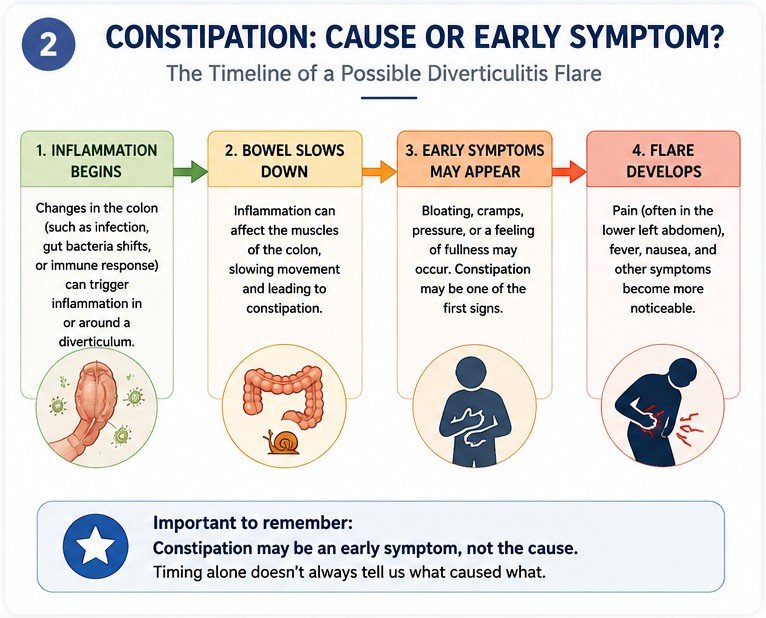
Inflammation May Start Before You Feel It
Diverticulitis doesn’t usually appear instantly.
Long before severe pain develops, the lining of the colon may already be becoming inflamed. As inflammation increases, the muscles of the colon don’t always contract as efficiently as they normally do.
When that happens, stool moves more slowly through the intestine.
The result?
Constipation.
In other words, constipation may sometimes be one of the first symptoms of a developing flare, rather than the event that triggered it.
Researchers don’t believe this explains every case, but it fits what many gastroenterologists observe in clinical practice.
It also helps explain why so many people feel guilty after a flare.
They remember being constipated first and assume they somehow caused the inflammation, when the inflammation may already have been quietly developing.
That’s an important distinction because it changes the conversation from blame to understanding.
Why This Matters
Imagine someone catches the flu.
The day before they develop a fever, they feel unusually tired.
It would be incorrect to say that feeling tired caused the flu.
Fatigue was simply one of the earliest signs that the illness had already begun.
Constipation can work the same way.
Sometimes it’s part of the disease process—not the cause of it.
Does Straining Cause Diverticulitis?
This is another question we hear frequently.
If constipation leads to straining, could the extra pressure damage the diverticula?
It’s a reasonable theory, but current research doesn’t provide convincing evidence that a single episode of straining triggers diverticulitis.
That doesn’t mean straining is harmless.
Repeated straining can contribute to problems such as:
- Hemorrhoids
- Anal fissures
- Pelvic floor dysfunction
- Rectal prolapse in some people
But when it comes to diverticulitis, the evidence simply isn’t there to say:
“You strained too hard, and that’s why you developed a flare.”
The colon is a remarkably strong organ.
Normal activities—including coughing, lifting groceries, climbing stairs, or having a bowel movement—create temporary increases in abdominal pressure every day.
If pressure alone caused diverticulitis, we’d expect to see flares after many routine activities, but we don’t.
Instead, researchers increasingly believe inflammation develops because of a combination of biological factors rather than one isolated event.
Clinical Insight
Many people are afraid to have a bowel movement during a diverticulitis flare because they’re worried they’ll make the inflammation worse.
In reality, gentle bowel movements are a normal part of recovery. If constipation becomes severe or painful during a flare, it’s important to discuss it with your healthcare provider rather than simply trying to “push through.”
Can Hard Stool Damage a Diverticulum?
Another common concern is whether a hard piece of stool can scrape or injure one of the diverticula.
Years ago, doctors believed this was a likely explanation.
Today, that theory has largely fallen out of favor.
Modern research suggests diverticulitis isn’t simply caused by something becoming trapped inside a pouch.
Instead, scientists believe changes in the bacteria living inside the colon, the body’s immune response, and chronic low-grade inflammation are much more important factors.
That doesn’t mean hard stools are comfortable—they certainly aren’t.
They can increase bloating, cramping, and abdominal discomfort.
But current evidence doesn’t support the idea that one hard bowel movement suddenly injures a diverticulum and causes diverticulitis.
Why Staying Regular Still Matters
At this point, you might be wondering:
“If constipation doesn’t cause diverticulitis, should I even worry about it?”
The answer is yes—but for different reasons.
Regular bowel habits are one sign of a healthy digestive system.
People who have frequent constipation are also more likely to have habits that can affect overall colon health, including:
- Eating too little dietary fiber
- Drinking inadequate fluids
- Sitting for long periods each day
- Getting very little physical activity
- Taking medications that slow the bowel
These habits don’t guarantee you’ll develop diverticulitis.
But improving them benefits your digestive system in many other ways.
You’ll often feel less bloated, more comfortable, and have more predictable bowel movements.
And if you do experience abdominal pain in the future, it may be easier to recognize when something unusual is happening.
What This Means for You
One of the biggest takeaways from current research is this:
Don’t blame yourself for every flare.
Many people spend days replaying everything they ate or every bowel movement they missed, searching for the one mistake that caused their diverticulitis.
Unfortunately, the human body rarely works that way.
Diverticulitis is influenced by many factors—some you can control and some you can’t.
Rather than focusing on a single episode of constipation, it’s more helpful to think about your overall digestive health over weeks, months, and years.
Small habits practiced consistently are far more important than one missed bowel movement.
Myth vs. Fact
| Myth | Fact |
|---|---|
| Constipation directly causes diverticulitis. | Current evidence does not support constipation as a direct cause of diverticulitis. |
| If I’m constipated, a flare is inevitable. | Most episodes of constipation do not lead to diverticulitis. |
| Straining once can damage a diverticulum. | There is no good evidence that a single episode of straining triggers diverticulitis. |
| If I’m constipated before a flare, I caused it. | Constipation may actually be an early symptom of inflammation that has already begun. |
| Preventing constipation isn’t important anymore. | Healthy bowel habits remain an important part of overall digestive health, even if they don’t completely prevent diverticulitis. |
How to Prevent Constipation When You Have Diverticulosis
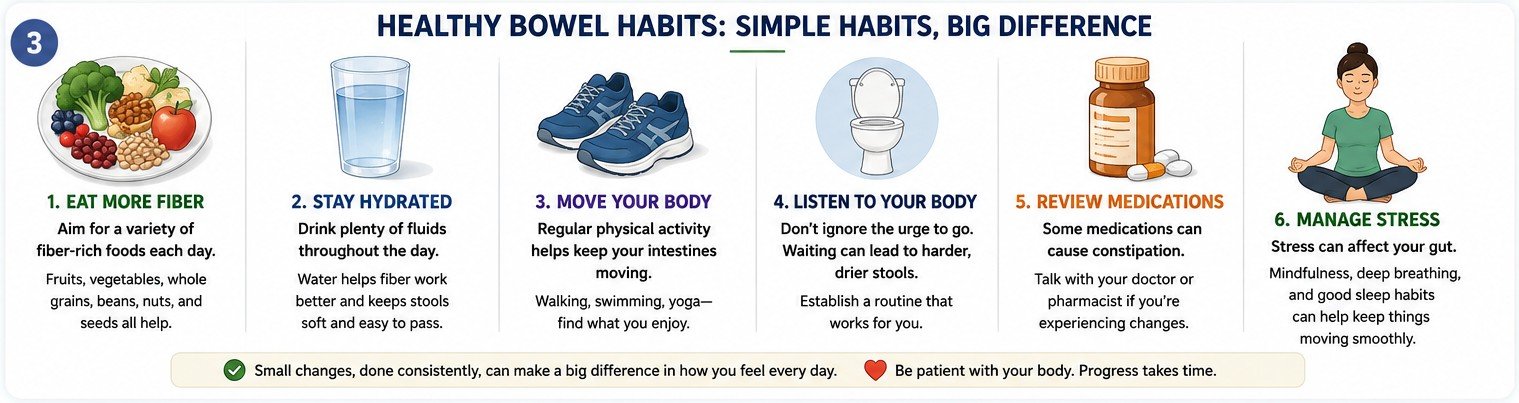
While constipation probably doesn’t cause diverticulitis, maintaining regular bowel movements is still one of the best things you can do for your digestive health.
The goal isn’t to have a bowel movement every day—despite what many people believe, that’s not necessary. Healthy bowel habits vary from person to person. Some people naturally go three times a day, while others go every other day and feel perfectly well.
Instead of focusing on frequency, pay attention to whether your bowel movements are:
- Easy to pass
- Well-formed but not hard
- Comfortable, without excessive straining
- Consistent for you
If you’re regularly straining, passing hard stools, or feeling like you haven’t completely emptied your bowels, it’s worth taking steps to improve your bowel habits.
Don’t Underestimate the Power of Fiber
Fiber has become almost synonymous with diverticular disease—and for good reason.
A diet rich in fiber helps soften stool, supports beneficial gut bacteria, and encourages regular bowel movements.
But there’s an important point that’s often overlooked.
Fiber is most helpful for preventing constipation between diverticulitis flares—not during an acute attack.
When diverticulitis is active, many healthcare providers recommend temporarily reducing fiber intake to allow the colon to rest. Once symptoms improve and your healthcare provider advises it’s safe, fiber is gradually reintroduced.
If you’re not currently experiencing a flare, aim to include a variety of fiber-rich foods such as:
- Oats
- Beans and lentils (if well tolerated)
- Berries
- Apples and pears
- Vegetables
- Whole grains
- Nuts and seeds (yes—even nuts and seeds are generally considered safe for most people with diverticulosis)
The old advice to avoid popcorn, nuts, seeds, and berries has largely been abandoned. Large studies have found no evidence that these foods increase the risk of diverticulitis.
The key is to introduce fiber gradually. Suddenly doubling your fiber intake overnight is more likely to leave you feeling bloated and uncomfortable than healthy.
Clinical Insight
One of the biggest mistakes people make after recovering from diverticulitis is becoming afraid of food.
We regularly hear from readers who eat very little because they’re worried another flare will happen. Ironically, eating too little fiber for weeks or months can make constipation worse and reduce the variety of beneficial bacteria in the gut.
Unless your healthcare provider has advised otherwise, the long-term goal after recovery is usually to return to a balanced, fiber-rich eating pattern.
Hydration Matters More Than Most People Realize
Fiber and water work together.
Without enough fluid, increasing fiber can actually make constipation worse.
Think of fiber as a sponge. It absorbs water as it moves through the digestive tract, helping create softer, bulkier stools that are easier to pass.
If that sponge doesn’t have enough water to absorb, stools can become dry and difficult to pass.
There isn’t one perfect amount of water everyone should drink. Your needs depend on your age, body size, activity level, climate, and overall health.
A practical approach is to:
- Drink regularly throughout the day instead of waiting until you’re thirsty.
- Increase your fluid intake during hot weather or exercise.
- Pay attention to the color of your urine—it should generally be pale yellow.
If you’ve increased your fiber intake but are still struggling with constipation, inadequate hydration is one of the first things worth reviewing.
Keep Moving
Exercise benefits far more than your heart.
Regular physical activity also helps stimulate the natural contractions of the intestines, encouraging stool to move through the colon more efficiently.
You don’t need an intense workout program to see benefits.
Simple activities like:
- Walking
- Swimming
- Cycling
- Gardening
- Yoga
can all support healthy bowel function.
If you’ve recently recovered from diverticulitis, ask your healthcare provider when it’s appropriate to resume exercise. For most people with uncomplicated diverticulitis, light activity can usually be restarted as symptoms improve, with a gradual return to normal exercise over time.
Could Your Medications Be Contributing?
Sometimes constipation has little to do with diet.
Several commonly prescribed medications can slow bowel movements, including:
- Opioid pain medications
- Certain antidepressants
- Iron supplements
- Calcium supplements
- Some blood pressure medications
- Anticholinergic medications used for bladder problems or allergies
If constipation developed shortly after starting a new medication, don’t stop taking it on your own.
Instead, speak with your healthcare provider or pharmacist. They may be able to adjust the dose, recommend an alternative, or suggest a safe way to manage the constipation.
Should You Take a Fiber Supplement?
If you’re struggling to get enough fiber from food alone, a fiber supplement may help.
Products containing psyllium are among the most widely studied and are commonly recommended for improving stool consistency and supporting regular bowel movements.
The key is to start slowly.
Adding too much supplemental fiber too quickly can lead to bloating, cramping, and excess gas.
It’s also important to drink plenty of water when taking fiber supplements to help them work as intended.
Fiber supplements shouldn’t replace a healthy diet, but they can be a useful tool for people who consistently fall short of their daily fiber needs.
When Constipation Is a Sign You Should See a Doctor
Most episodes of constipation can be managed with dietary and lifestyle changes.
However, constipation accompanied by any of the following symptoms deserves prompt medical attention:
- Severe or worsening abdominal pain
- Fever or chills
- Persistent vomiting
- Blood in the stool
- An inability to pass stool or gas
- A swollen or rigid abdomen
These symptoms may indicate something more serious than routine constipation, including diverticulitis or another condition that requires urgent evaluation.
Likewise, if constipation lasts for several weeks despite increasing fiber, fluids, and activity, it’s worth discussing with your healthcare provider to look for an underlying cause.
What This Means for You
Perhaps the most important lesson from current research is this:
Don’t think of constipation as your enemy.
Think of it as a signal.
Sometimes it’s a sign that your diet needs more fiber.
Sometimes you’re dehydrated.
Sometimes you’re not moving enough.
Sometimes a medication is slowing your bowel.
And occasionally, it may be one of the earliest clues that inflammation is already developing.
Instead of blaming yourself, pay attention to the pattern.
Looking at the bigger picture is far more helpful than focusing on one difficult bowel movement.
Frequently Asked Questions
Can constipation be an early symptom of diverticulitis?
Yes, it can be.
While many people assume constipation causes diverticulitis, the opposite may sometimes be true. As inflammation develops in the colon, bowel movements can slow down, leading to constipation before more recognizable symptoms—such as abdominal pain or fever—appear.
Constipation on its own is common and usually isn’t a sign of diverticulitis. However, if it’s accompanied by worsening abdominal pain, fever, nausea, or chills, you should contact your healthcare provider.
Can straining during a bowel movement cause diverticulitis?
Current research doesn’t support the idea that a single episode of straining causes diverticulitis.
Repeated straining isn’t good for your body—it can contribute to hemorrhoids and other pelvic floor problems—but there is no convincing evidence that one difficult bowel movement triggers inflammation in a diverticulum.
The best approach is to prevent chronic constipation rather than worrying about occasional straining.
Does constipation increase pressure inside the colon?
Yes, constipation and straining can temporarily increase pressure inside the colon.
Years ago, this was thought to be the primary reason diverticulitis developed.
Today, researchers believe the condition is much more complex. Changes in the gut microbiome, immune function, genetics, and chronic inflammation appear to play a much larger role than pressure alone.
Should I take a laxative if I have diverticulosis?
It depends.
If you’re dealing with occasional constipation and have diverticulosis—but not an active diverticulitis flare—your healthcare provider may recommend dietary changes, increased fluid intake, or a fiber supplement before suggesting a laxative.
If lifestyle measures aren’t enough, some people benefit from an osmotic laxative such as polyethylene glycol (PEG), but it’s important to discuss persistent constipation with your healthcare provider to make sure there isn’t another underlying cause.
If you think you’re having a diverticulitis flare, don’t start a new laxative without medical advice.
Can constipation come back after diverticulitis?
Yes.
Many people notice changes in their bowel habits after recovering from diverticulitis.
For some, bowel movements gradually return to normal over several weeks. Others continue to experience constipation or alternating constipation and diarrhea, particularly if they have irritable bowel syndrome (IBS), which can overlap with diverticular disease.
If constipation persists or becomes progressively worse, it’s worth discussing with your healthcare provider.
Is fiber enough to prevent diverticulitis?
Probably not.
A fiber-rich diet remains an important part of long-term digestive health, but no single food or supplement has been proven to completely prevent diverticulitis.
Current evidence suggests that overall lifestyle matters more than any one dietary change.
That includes:
- Eating a balanced, fiber-rich diet
- Staying hydrated
- Exercising regularly
- Maintaining a healthy weight
- Not smoking
- Managing other health conditions, such as diabetes, when present
Think of these habits as working together rather than relying on one “magic” solution.
Five Things I Want You to Remember
If you take only a few points away from this article, let them be these:
- Constipation alone probably doesn’t cause diverticulitis. Current research suggests the condition is much more complex than doctors once believed.
- Constipation may sometimes be an early symptom of a flare rather than its cause. If constipation is followed by increasing abdominal pain or fever, seek medical advice.
- Healthy bowel habits are still important. Eating enough fiber, drinking plenty of fluids, and staying active all support good digestive health—even if they don’t guarantee you’ll never develop diverticulitis.
- Don’t blame yourself. Many people replay everything they ate or every bowel movement they missed before a flare. In reality, diverticulitis develops because of a combination of factors, many of which are outside your control.
- Look at the bigger picture. Long-term lifestyle habits matter far more than one day of constipation.
The Bottom Line
If you’ve ever wondered whether constipation triggered your diverticulitis, you’re certainly not alone.
It’s one of the most common questions people ask after a flare—and for years, even doctors believed the answer was yes.
Today, we know it’s not that simple.
Constipation doesn’t appear to directly cause diverticulitis. Instead, it may sometimes be one of the earliest signs that inflammation is already developing. More importantly, diverticulitis is now understood as a complex condition influenced by genetics, the gut microbiome, immune responses, diet, and overall lifestyle.
That doesn’t mean constipation should be ignored.
Keeping your bowels regular through a balanced diet, adequate hydration, physical activity, and healthy daily habits is still an important part of caring for your digestive system. These steps may not eliminate your risk of diverticulitis, but they can improve your overall colon health and help you feel your best.
Finally, remember that no one develops diverticulitis because they “failed” to have a bowel movement one day.
If there’s one message we hope you take away from this article, it’s this:
Focus on building healthy habits over time—not on blaming yourself for a single episode of constipation.
Related Links
- High-Fiber Diet for Diverticulosis
- Low-Fiber Diet
- Best Foods to Eat After Diverticulitis
- Diverticulitis Liquid Diet Guide
References
- Peery AF, Barrett PR, Park D, et al. A high-fiber diet does not protect against asymptomatic diverticulosis. Gastroenterology. 2012;142(2):266-272.e1. doi:10.1053/j.gastro.2011.10.035
- Strate LL, Morris AM. Epidemiology, pathophysiology, and treatment of diverticulitis. Gastroenterology. 2019;156(5):1282-1298.e1. doi:10.1053/j.gastro.2018.12.033
- Stollman N, Smalley W, Hirano I. American Gastroenterological Association Institute Guideline on the Management of Acute Diverticulitis. Gastroenterology. 2015;149(7):1944-1949.
- Feingold D, Steele SR, Lee S, et al. Practice Parameters for the Treatment of Sigmoid Diverticulitis. Diseases of the Colon & Rectum. 2014;57(3):284-294.
- Hall J, Hardiman K, Lee S, et al. The American Society of Colon and Rectal Surgeons Clinical Practice Guidelines for the Treatment of Left-Sided Colonic Diverticulitis. Diseases of the Colon & Rectum. 2020;63(6):728-747.
- National Institute of Diabetes and Digestive and Kidney Diseases. Diverticular Disease. National Institutes of Health. Updated 2024.
- Strate LL, Liu YL, Syngal S, Aldoori WH, Giovannucci EL. Nut, corn, and popcorn consumption and the incidence of diverticular disease. JAMA. 2008;300(8):907-914. doi:10.1001/jama.300.8.907
- Bharucha AE, Pemberton JH, Locke GR. American Gastroenterological Association Technical Review on Constipation. Gastroenterology. 2013;144(1):218-238. doi:10.1053/j.gastro.2012.10.028